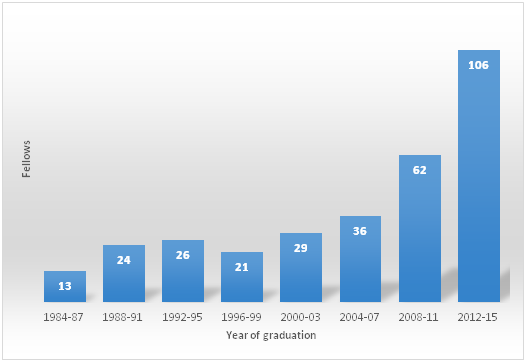
This means that for Nigerians, with a population of 182 Million, the College has been able to produce 1 Ophthalmologist to 530,000 Nigerians, as against the WHO target of 1 Ophthalmologist to 250,000 people (IAPB, 2014). We do not have enough Ophthalmologists to manage eye diseases in Nigeria. Achieving the goals of the new WHO Action plan (a 25% reduction in blindness and visual impairment by 2019) for Universal eye health coverage will be impossible without addressing the eye health workforce crisis (WHO, 2013).
By the grace of God, I have contributed to the training of not less than 24 Ophthalmologists while 19 other doctors are currently in training.
Why would you keep your trade to yourself and not pass it on to the next generation?
Incorporating Eye Health Care within the Primary Health Care
The Alma-Ata Declaration of 1978 expressed the need for urgent action by all governments, health and development workers, and the world community to protect and promote the health of all people. In achieving the goals of Universal Eye Health, it is desirable to incorporate Primary Eye Care (PEC) within the pre-existing Primary Health Care to effectively reach rural communities. In furtherance of this, we conducted a study to assess the human and material resources available for primary eye-care delivery in rural communities. We found that in 27 health facilities available in Atakunmosa LGA, forty-one (42%) community health extension workers, 42 (43%) health assistants, 3 (3%) community officers of health and 11 (11%) registered nurses administered PHC. No worker had training in PEC and none of the centres had all the materials for basic PEC delivery. Although procurement of materials and training of health-workers in basic PEC delivery is required, the healthcare facilities and workers currently available were found to be adequate to commence integration of PEC into the PHC system. (Onakpoya, Adeoye et al, 2009).
It is heartwarming to note that only last month, the Federal Ministry of Health launched the Rapid Result Initiative programme, called: “Better Health for all,” made to produce quick and visible impact on the lives of every Nigerian especially, the most vulnerable and poor in the society. Under this programme, 110 Primary Health Centres all over Nigeria would be revamped within 100 days. It is hoped that by this, health care delivery will be brought closer to the underserved communities.